|
1JZ Swap
Ever since I started swapping in a 2JZ in the MA7 body (my own car), I wanted
to install a 1JZ engine in a left hand drive mk3 Supra also. The 1JZ engine came
stock in the mk3 Supra in Japan from 89 to 92, as a replacement of the 7M
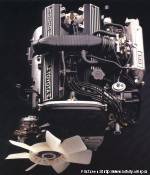
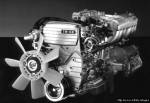
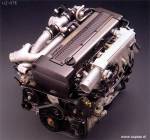
engines. The 1JZ engine is the 'smaller brother' of the 2JZ engine, which came
in the mk4 Supra worldwide. A 1JZ engine is a 2.5 liter twin turbo engine. The
engine was a Japanese model to make the transition between the M based Supras
and the newer model, with the 3 liter twin turbo engines (2JZ engines). The 1JZ
engine features a very short stroke, so it is a higher rev engine. The red line
is around 7000 RPM and the rev limiter is around 7250 RPM! The nice thing about
swapping in a 1JZ is you don't have to make that many alterations to your MA70
as with the 2JZ. The stock twins fit the engine bay (firewall) without a
problem, and so do all other parts. Maybe the oil filter is in an awkward
position on LHD vehicles, but you can always put an oil relocation kit there,
solving this problem. The wiring harness needs lengthening up, as it's about 3
feet too short, but this can be done easily as everything is color coded. This
article describes how we did the engine swap and what went good and what went
wrong. Hope you all can learn from this.
The story starts in December. I'm a member of the UK Supra Owners group.
Almost anywhere in the world people drive on the right side of the road, but in
England they drive on the wrong side.. uh.. sorry, the left side. This makes the
UK market a very good place to drop off all wrecks from Japan. A lot of
Japanese-brand cars in the UK are Jap-import. These cars are not first sold in
the UK, but in Japan after which they get sold as a second hand car in the UK.
Models like the R33 and R34 skyline, JZA70, GA70 and 20 valve 4A-GE equipped
cars never made it to Europe, but they are all available as Jap imports in the
UK. One guy on the UK mailing list posted a message that he had dropped the
price on his JZA70 from 2500 pound sterling to 2000 pound sterling. Which is
around 3100 euro/dollar, for a complete, nice and drivable car! I would say a
steal! Normal front cuts go around 1500 dollar if you're lucky, and shipping on
those items is very high! This car could easily be acquired and driven back home
to Amsterdam. Now I only needed to find a car that was ready for dropping the
engine in. This was the car of Marcel, a friend of mine, who always wanted to
have a JZ engine in his car also.
| So on December 29th of 2002, both Marcel and me took the el
cheapo airplane (easyjet) from Amsterdam to Liverpool to meet up with Mark
the seller. Here is a picture of the car he picked us up with. It was a
full options black JZA70, lowered and leather interior. The bad sides on
it was it had an automatic transmission and stock rims. |
 |
 |
The rear looked awesome. The car had the newer style
taillight setup, which was never sold in Europe because the big euro
license plates don't fit. Marcel's car already has this taillight setup,
but his lights were full of water and the middle plate had a big crack, so
we could use this new taillights setup.
The car was lowered also, with KYB shocks. Good setup. The exhaust was a
mess, but hey, can't have everything can you! |
| We drove the car to Harwich, which was less than 5 hours
trip. We were in time to catch the evening boat, instead of the night boat
we planned for. Around 1 AM we arrived back home, Marcel dropped me off at
my house and the next day we could start pulling the engine and the other
parts. Here is one last picture on the engine in it's original place, so
that we know where everything goes! |
 |
 |
We took off the bumper and the fenders to easily get to the
engine and to prevent them from getting scratched. Our plan is to convert
marcels red car to black with all these body panels, as his car has
multiple colors because of weather influence. The red paint has turned
pink on the right fender, his bumper is ugly and hood has weird dents in
it. With all the black parts we can turn his car in a way better shape! In
the picture Marcel is checking the engine to see if it comes out by
itself. |
| Pulling the engine is not that difficult. You do this just
like the 7M engine, with the transmission. There is less room between the
firewall and the engine so take good care not to damage anything. |
 |
 |
The engine is out of the car. Easy job. From left to right
it's me, Marcel, Jeroen and Leon. |
| We continued with stripping the car down. The seats where
removed and so was the dash and all upholstery. We took out the doors, the
windscreen. Everything. |
 |
 |
Even the rear fenders of the car where removed. Jeroens
Supra had a lot of rust on these pars and it's not every day we have a
good donor car available! |
| And this is what is left of the car. It's just one piece of
old iron, with a dashboard which is useless to us. Very cool detail is we
had 15 euro in return for this when we took it to the old iron company.
They melt it and make new cars out of it, hopefully another Toyota! But
maybe it's second life will become a t-spoon. |
 |
 |
We took the engine on the engine stand and removed all parts
on the intake side and on the front for cleaning. The engine will get a
new timing belt, 550cc mkIV fuel injectors and new gaskets and seals. The
plastic caps will be painted the bluish 'club colors' and the aluminum
intake will be polished. I sourced a set replacement turbos for this
engine, as the car smoked badly while idling (possible oil seals of the
turbos where gone), but these need to go on the engine later, as I can't
have them within a week (shipping from the states). |
| One of the main obstacles with building in a 1JZ in our cars
is lengthening up the wiring harness. The ECU on the japanese spec cars is
on the left hand side, the same side the harness enters the engine. Our
ECU is on the right hand side (behind the glovebox), so we need to
lengthen up the harness by about 3 feet. I decided to lengthen up the
harness only and use the dashboard connectors of the JZA car to solder in
our car. Lengthening up is an easy job and the few connectors I needed I
had in stock laying around somewhere in a box. |
 |
 |
This is the square connector under the dash of the 1JZ. It
has 15 pins. The pins have the following meaning:
| 1. White - Red |
Progressive power steering + |
| 2. Black |
Heater control valve switched to ground |
| 3. Black - Red |
Switched +12v from fusebox (EFI) |
| 4. Yellow |
Fuel pump control relay coil |
| 5. Black - Blue |
Start signal for starter (fat wire) |
| 6. Green |
Signal for circuit opening relay |
| 7. Black - Red |
FP signal checkbox from fuel pump relay |
| 8. White - Green |
Progressive power steering - |
| 9. Blue - Red |
A/C signal from A/C ECU to engine ECU |
| 10. Black - White |
Starter signal for NSW (fat wire) |
| 11. Grey |
IGSW signal from ignition fuse |
| 12. Red - Blue |
O/D signal fro Cruise control from ECU |
| 13. Red - Green |
SP2 signal from ECT for cruise control |
| 14. Black |
Ignition + for ignition coils and injectors (FAT) |
| 15. White - Blue |
To Fan ECU |
|
The white connector pictured here on the right, is for the
main signals to the car. The pin out is:
| 1. Brown |
AB (airbag) signal check box |
| 2. Green - Orange |
ECT Power switch |
| 3. Red - Yellow |
trip counter signal (white-red) |
| 4. Black |
L1 |
| 5. Green - Yellow |
Solenoid 2 from ECT to Cruisecontrol |
| 6. Violet |
Ts signal checkbox (TEMS) |
| 7. Yellow |
RR- rear ABS speed sensor |
| 8. Black |
RR+ rear ABS speed sensor |
| 9. Yellow |
Oil level light switch |
| 10. Light Green- Red |
Auto gearbox indication "2" |
| 11. Blue |
Check signal cruise (Tc) |
| 12. Orange |
?? |
| 13. Grey |
O/D signal (not sure) |
| 14. Red |
L2 |
| 15. Red - White |
L3 |
| 16. N.C. |
N.C. |
| 17. Blue - Yellow |
Rear speed signal for ECT from ABS |
| 18. Black |
IG- (RPM) |
| 19. Red - Yellow |
ELS signal |
| 20. Red - Black |
PSEN for ABS |
| 21. Blue - White |
From tripple hi-low pressure to cooling fan computer |
| 22 Yellow - Red |
to grey connector pin 25 |
| 23. Blue |
Auto gearbox indication "L" |
|
 |
 |
| 1. |
N.C. |
| 2. Brown |
Ground (for exh. temp etc) |
| 3. Yellow |
+12 v for auto gear indication |
| 4. Green - white |
Stop signal from footbrake |
| 5. |
N.C. |
| 6. |
N.C. |
| 7. Yellow - Green |
Water temp for dashboard |
| 8. Pink |
Speed signal |
| 9. |
N.C. |
| 10. Black - Blue |
Start signal for circuit opening relay |
| 11. Black |
Tach signal for combination meter |
| 12. |
N.C. |
| 13. Green - Black |
exh. temp sensor CCO check box |
| 14. Red |
'P' signal auto gearbox indication |
| 15. White |
'N' signal auto gearbox indication |
| 16. Violet |
'D' signal auto gearbox |
| 17. |
N.C. |
| 18. Brown |
Ground for ECU etc. |
| 19. Grey - Green |
Check engine light 'W' checkbox |
| 20. Yellow - Blue |
Exh. temp warning light |
| 21. Yellow - Black |
|
| 22. Grey - Green |
Check engine light |
| 23. Yellow - Red / Yellow - Black |
Oil pressure switch |
| 24. Black - Red |
Back up lights + 'R' signal |
| 25. Yellow - Red / Yellow - Blue |
To white rect. connector pin 22 |
|
At the fusebox, there is another connector to power the
whole engine and ECU. This connector has 12 pins:
| 1. Black - Yellow |
+12 v EFI unswitched |
| 2. Black - Orange |
M-REL EFI main relay |
| 3. light green |
OPT, water sensor in rad |
| 4. Blue / Blue - Red |
A/C speed sensor |
| 5. Black - Red |
+12v EFI switched |
| 6. Black - Red |
To temp sensor in rad |
| 7. Brown |
ACMG from ECU to clutch |
| 8. Light Green - Red |
A/C speed sensor |
| 9. Blue |
A/C magnetic clutch from relay |
| 10. Yellow - Green |
Charge warning light alternator |
| 11. White |
AM1, ALT + |
| 12. Black - Yellow |
to Alternator from engine / gauge fuse |
|
 |
The approach we did with the wiring harness has
a few pro's and con's. There are three good points on lengthening up the
harness only. One is the simplicity; you don't have to care about
soldering in your 7M dash connectors, the second is you get all 1JZ
connectors in the car, which results in more pins. These pins can be used
for aftermarket electronics (like oil temperature gauge) or the predefined
function, which can result in extra gauges or lights (like the oil
pressure switch and the oil level light). The last thing which votes in
favor of lengthening up the harness only, is you can still drive around
your 7M while you work on the engine swap; you don't need the dashboard
connectors. In case you are going to buy my harness from SupraSport.Com
or from my own online shop, you can exchange your old harness after you
have done the swap, so this is not a real problem.
There is only one real problem with putting in the dashboard connectors on
the MA70. You really have to remove the complete dashboard from the car
and then solder in all these connectors. This is just an awful lot of
work, but again, it pays off. I would vote this as the best option, unless
you don't care of having your car grounded for a few weeks, or if you
would like to be able to build it back in the original status. |
 |
when making the cuts and the connections, always use proper
soldering technique. Label the wires in groups and use the correct size
shrink wrap to isolate the connections. Don't cut the harness at one
place, cause this will result in a big bump somewhere. Cut in various
places. If you don't have the skills to make such a harness, buy my
harness at the online shop or at suprasport.com, or buy Mike Urbano's
harness which is very good also! |
| Here you see the harness finished. Marcel (on the left) and
me on the right. He's already smiling which means he starts to believe it
is going to work!
We're going to tape the harness in it's form when it is on the engine.
This is easier than taping it beforehand, cause you always have to put it
in some bends or directions. |
 |
 |
After the harness is lengthened up, putting it back on the
engine is needed for getting it back in it's form. When everything is in
the right spot, you can tape it back. We've changed the fuel injectors of
the 1JZ engine from those of the 2JZ export engine (550cc). These
injectors are low impedance so we had to wire in the 7M resistor back. Two
injectors are fired up in a batch, in the same way the 7M used the
injectors. |
| One of the main things to adjust is the power steering
system. On our cars the steering wheel and thus the power steering
connections are on the left hand side of the car, while the 1JZ cars have
the connections on the right hand side. You can use the power steering
hose of the LHD JZA80 models, but you can go to a local hydraulics shop
and get some clamp connections also, like in the picture. |
 |
 |
We bought the JZA70 with an automatic transmission, but we
have changed this to manual. For a manual swap you need the JZA70 manual
bellhousing which bolts straight up to the R154 tranny MA70 tranny. A new
flywheel is needed also, which can use the stock clutch and stock pressure
plate. A new tube for the clutch is needed also. All these parts can be
sourced via me or at suprasport.com |
| Putting the engine in the car can be a real pain. It is a
very tight fit, but it DOES fit. Assuming you have the late model round
engine mounts and the correct crossmember, otherwise you have to swap that
over also. |
 |
 |
Here you see a good picture on the clearance on the rear
turbo. Remember my own car, the 2JZ? That twin turbo system does not fit
in the car, but this 1JZ is a very very tight fit, but it does fit! |
| This is a snapshot of what is required to get the dash
connectors installed in the car. Again, this is not how the regular
suprasport.com / supras.nl harness will look like, this just prevented us
from having the car off the road for longer than a few days. And we had a
lot more signals available for all new gadgets and gauges. Again: this is
for the advanced electronics guys. I really advice you to either build
your own harness with the 7M dash plugs, or buy one from me or Mike. |
 |
 |
Under the JZ engine, we have mounted a little metal pre
cooler, which is used for getting the PS fluid from left, to right and
back to left, so it can come from the bump to the steering rack. Again,
you can use the JZA80 lines, but these are about 250 dollar from the
dealer, while our setup was only 50 dollar or so. |
| One good thing of stripping a car is you have a lot bolts
left. Look at this!!! |
 |
 |
Here you see a good picture of the JZ throttle cable we
used. The cable is off the JZA80. Not a perfect fit if you ask me. This
swap is advised by everyone on the mailing list, but I would make one
myself, just as I did with the 2JZ swap on my own car. |
| The harness I make uses the JZ fusebox connector. This
connector has the wires for the alternator also, so you can remove those
from the car and solder them to the other connector on the car. As you see
we've adapted the 'M' engine fuel injector resistors also, as we switched
to 550cc injectors. |
 |
 |
On the JZA70 the condenser fan is driven with an oil pump
which is connected to the waterpump. We've replaced this pump with the
water pump off the 2JZ-GTE engine. This engine has a clutch driven fan.
The electric fans (we use two big fans, so no clutch fans are needed), are
driven with the blue temperature sensor of the 7M engine. Works flawless.
I haven't figured out how the fan ECU and the temp sensor in the JZA70
radiator works yet. |
| And the final picture: After the swap

|
| And a picture on the 'before':

|
| That's it. All was done in a few days. We did
the full body swap also, the car is now red with all black body panels.
We're waiting for the paintjob!!! |
|